
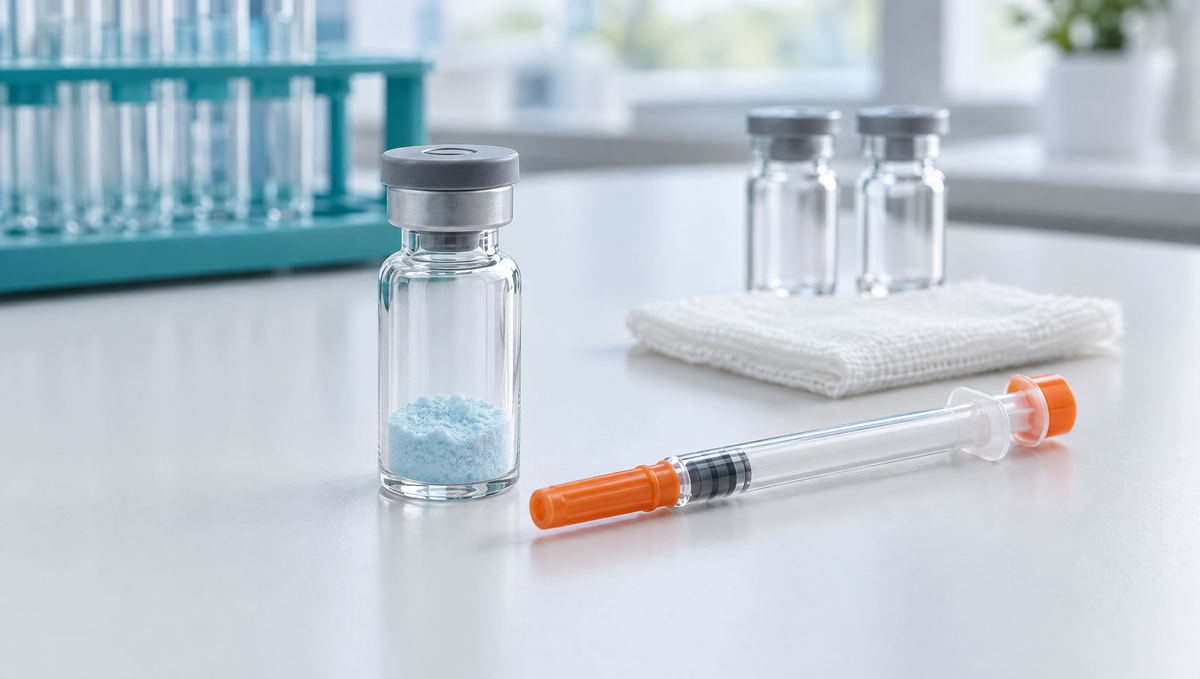
Klow peptide: key takeaways
Klow is a vendor-built research blend of GHK-Cu, KPV, BPC-157 and TB-500, and no human study has tested the combination.
- Two vial compositions circulate: 55 mg with GHK-Cu 25 mg (supplier vial) and 80 mg with GHK-Cu 50 mg (dosing guides).
- Component data are mostly preclinical: small uncontrolled BPC-157 pilots, topical GHK-Cu studies, and animal or lab work for KPV and TB-500.
- Reported use for the 80 mg variant is 7.5, 15 and 22.5 units once daily, then a taper of 15 units per day.
- On a U-100 syringe, concentration in mg per ml equals vial content divided by solvent volume, and units equal ml times 100.
Jump directly to the dosage chart, reconstitution or Klow vs Glow. For the three-peptide blend without KPV, see the Glow Stack guide.
What is Klow peptide?
Klow is an informal vendor name for a four-peptide research blend of GHK-Cu, KPV, BPC-157 and TB-500 sold as a lyophilized vial, not a standardized formulation. The name was coined by vendors and has no pharmacopeial definition.
Which molecule a vial contains is a separate question. BergdorfBio describes its KPV as the free acid H-Lys-Pro-Val-OH, while other suppliers advertise Ac-KPV-NH2, an acetylated and amidated variant and a different substance. For TB-500, only the mass spectrometry value on the certificate of analysis separates the fragment Ac-LKKTETQ from full thymosin beta-4.
The vendor formula "Klow equals Glow plus KPV" needs a note on the vial. For the 80 mg variant used in dosing guides it holds numerically, because Glow is 70 mg and KPV adds 10 mg. The 55 mg vial adds KPV 10 mg and at the same time halves GHK-Cu from 50 mg to 25 mg.
The Klow Stack research blend is offered for research use, and all composition figures below are supplier data.
Klow blend composition: 55 mg and 80 mg vials
The 55 mg vial contains GHK-Cu 25 mg, TB-500 10 mg, BPC-157 10 mg and KPV 10 mg, while many dosing guides calculate with an 80 mg vial that holds GHK-Cu 50 mg. Both figures are supplier data.
| Variant | GHK-Cu | KPV | BPC-157 | TB-500 | Total active peptide |
|---|---|---|---|---|---|
| Klow, supplier vial (BergdorfBio) | 25 mg | 10 mg | 10 mg | 10 mg | 55 mg |
| Klow 80 mg variant (dosing guides) | 50 mg | 10 mg | 10 mg | 10 mg | 80 mg |
| Glow Stack (supplier vial, for comparison) | 50 mg | not included | 10 mg | 10 mg | 70 mg |
At the same solvent volume, units of the 55 mg vial deliver the same amounts of KPV, BPC-157 and TB-500 as units of the 80 mg variant but half the GHK-Cu; the 55 mg supplier documents no solvent volume. The unit schedules below therefore come from the 80 mg variant.
Klow peptide benefits: what each component is researched for
Each component has a separate research profile, and no published study has shown that the four work better together than alone. The sections below summarize what each substance is and where it has been studied.
KPV: the anti-inflammatory tripeptide
KPV is the C-terminal tripeptide of alpha-MSH (lysine, proline, valine). In cell and animal models it reduced NF-kB and MAP-kinase signaling, reached cells via the PepT1 transporter and kept the anti-inflammatory activity of alpha-MSH without a pigmentation effect. No human study has established efficacy, pharmacokinetics or dose. KPV research material is sold as a lyophilized vial.
GHK-Cu: the copper peptide
GHK-Cu is the copper(II) complex of the endogenous tripeptide GHK, isolated from human serum in 1973 by Pickart and Thaler. In fibroblast cultures it increased collagen synthesis starting at 10-12 to 10-11 M, with a maximum at 10-9 M (Maquart et al. 1988). Human data remain thin: of 11 human studies from 2005 to 2026, three tested GHK-Cu as the experimental intervention (Najafi 2026). The GHK-Cu guide covers the single substance, and GHK-Cu is sold as a separate vial.
BPC-157 and TB-500: tissue repair research
BPC-157 is a synthetic pentadecapeptide (GEPPPGKPADDAGLV) studied mainly in rodent models of tendon, gut and vessel repair, with VEGFR2 activation proposed as one mechanism in cell and rat work (Hsieh et al. 2017). TB-500 is the acetylated fragment Ac-LKKTETQ of thymosin beta-4 (residues 17 to 23); results from full thymosin beta-4 cannot be transferred to it. Human data for BPC-157 are three small uncontrolled pilots (Lee 2021, Lee 2024, Lee 2025), and for TB-500 there are none. See the BPC-157 and TB-500 guides for details.
Research and evidence
No human study has tested the Klow blend; the evidence comes from lab and animal work on each component, a few small human studies of BPC-157 and topical GHK-Cu, and one rat study in which BPC-157 plus TB-500 showed no added benefit.
In that rat study of transected Achilles tendons, both peptides improved histology, only TB-500 improved biomechanical strength significantly, and the combination added nothing over the single substances (Biçer et al. 2026). No published study has tested GHK-Cu with KPV or the four-peptide blend.
Klow components at a glance
| Component | Structure | Research focus | Human evidence |
|---|---|---|---|
| KPV | tripeptide Lys-Pro-Val, residues 11 to 13 of alpha-MSH (free acid or Ac-KPV-NH2, depending on the product) | PepT1 uptake, NF-kB and MAP-kinase | none |
| GHK-Cu | copper(II) complex of GHK | collagen, matrix, wound models | topical only, thin |
| BPC-157 | pentadecapeptide GEPPPGKPADDAGLV | VEGFR2 angiogenesis, tendon and gut models | three small uncontrolled pilots |
| TB-500 | Ac-LKKTETQ, residues 17 to 23 of thymosin beta-4 | actin-binding motif (hypothesis) | none |
Klow peptide dosage
There is no approved or studied Klow dose, and the figures below are reported use from supplier pages and dosing guides, not recommendations from a health authority. The study table and the practice table are kept separate for that reason.
Dosage in studies (no blend data)
Published research contains no Klow dosing scheme, only separate amounts for single substances in cell, animal and small human studies.
| Substance | Model or population | Route | Amount | Note |
|---|---|---|---|---|
| KPV | mice, DSS and TNBS colitis | oral in drinking water | 100 µmol/l (about 34.2 mg/l) | no mg-per-day figure in the paper (Dalmasso et al. 2008) |
| GHK-Cu | human studies | topical | 0.05 to 2 percent | only human form studied (Najafi 2026) |
| BPC-157 | 17 patients, knee pain | intra-articular | 2 to 4 mg, 1 to 2 injections | retrospective (Lee and Padgett 2021) |
| TB-500 | humans | no human study | not applicable | the FDA found no clinical TB-500 studies |
Single-substance amounts for GHK-Cu, BPC-157 and TB-500 are covered in the GHK-Cu guide, the BPC-157 guide and the TB-500 guide.
Klow peptide dosing protocol: reported use in practice
In practice one dosing guide describes the 80 mg variant as once-daily subcutaneous units over up to 12 weeks, while the 55 mg product page states no schedule.
| Source | Variant | Dose and units | Frequency and cycle | Notes |
|---|---|---|---|---|
| Independent dosing guide (peptidedosingprotocols.com) | 80 mg | 7.5 / 15 / 22.5 units | once daily subcutaneous, weeks 1 to 2, 3 to 4 and 5 to 8, then a taper of 15 units in weeks 9 to 12 | about 250, 500 and 750 µg KPV per day; the same guide also describes shorter 4 to 6 week cycles, and it gives the high GHK-Cu share (62.5 percent of the vial) as the reason for breaks between cycles |
| Supplier product page (BergdorfBio) | 55 mg | no schedule ("according to the respective research protocol") | not applicable | vendor statement, no dose |
| Supplier guide (BergdorfBio) | 55 mg and 80 mg | no schedule | not applicable | notes that single-component figures come from heterogeneous models and cannot be converted into one another |
Klow peptide dosage and frequency chart
For the 80 mg variant the guide uses 7.5, 15 and 22.5 units once daily in weeks 1 to 2, 3 to 4 and 5 to 8, then a taper to 15 units in weeks 9 to 12. The table shows its 12-week version.
| Week | Units per day (U-100) | Volume | Total peptide per day | GHK-Cu per day | KPV per day (approx.) |
|---|---|---|---|---|---|
| Weeks 1 to 2 | 7.5 | 0.075 ml | about 2.0 mg | 1.25 mg | about 250 µg |
| Weeks 3 to 4 | 15 | 0.15 ml | about 4.0 mg | 2.5 mg | about 500 µg |
| Weeks 5 to 8 | 22.5 | 0.225 ml | about 6.0 mg | 3.75 mg | about 750 µg |
| Weeks 9 to 12 (taper) | 15 | 0.15 ml | about 4.0 mg | 2.5 mg | about 500 µg |
The chart assumes an 80 mg vial dissolved in 3.0 ml of bacteriostatic water (about 26.7 mg/ml). Units and KPV figures come from the dosing guide; volumes, total amounts and the GHK-Cu share (62.5 percent of the vial) are calculated. At the same solvent volume the 55 mg vial delivers the same KPV, BPC-157 and TB-500 amounts per unit but half the GHK-Cu, and its supplier documents no solvent volume.
Klow dose per day
In one independent dosing guide, Klow is injected once daily: 7.5, 15 or 22.5 units of an 80 mg vial in 3 ml, which is about 2, 4 or 6 mg of blend, 250, 500 or 750 µg of KPV and 1.25, 2.5 or 3.75 mg of GHK-Cu per day.
How to reconstitute and inject Klow peptide
Reconstitution is one calculation chain: concentration in mg per ml equals vial content divided by solvent volume, and units on a U-100 syringe equal volume in ml times 100.
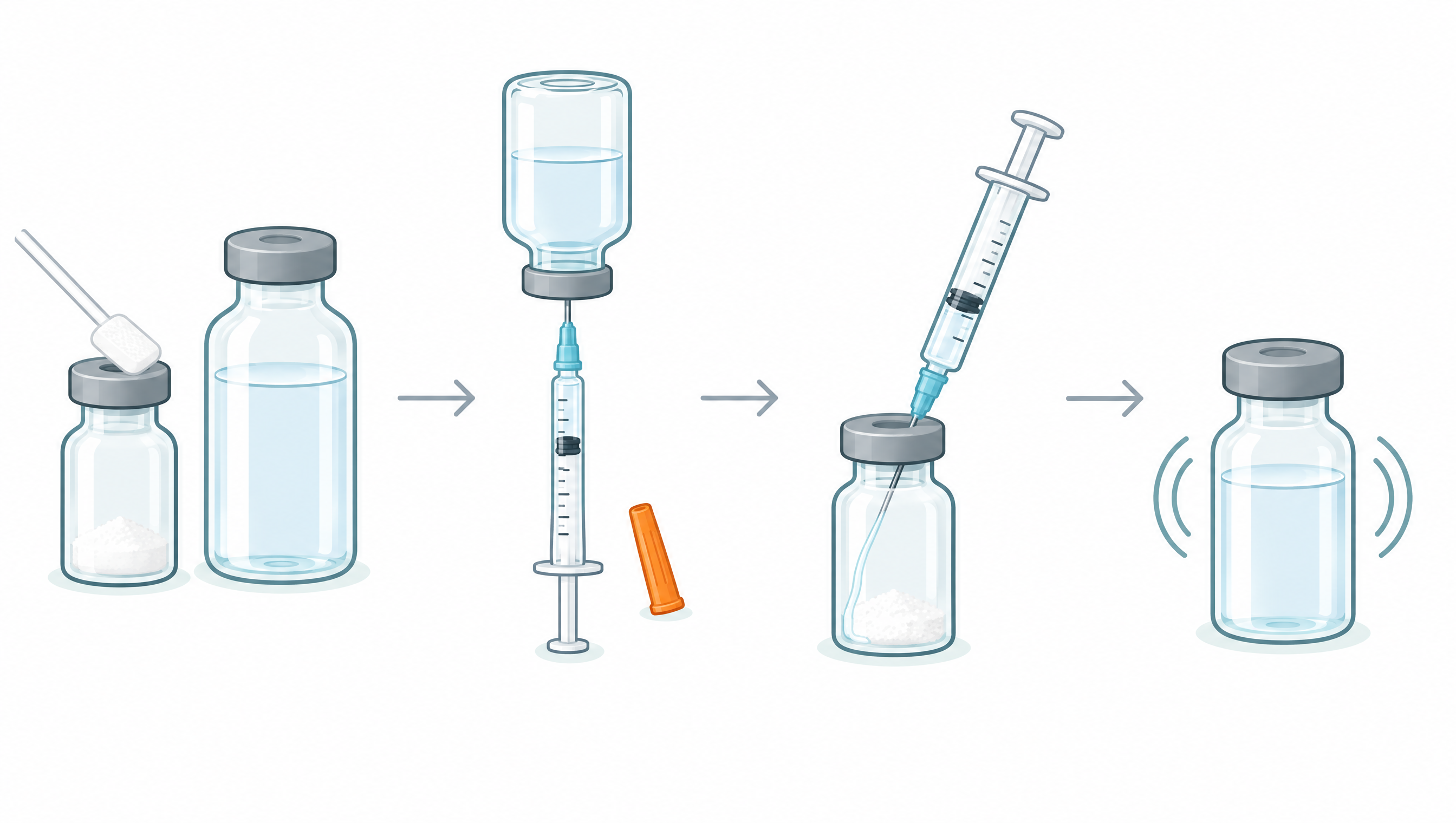
As solvent, use bacteriostatic water for injection (USP). It contains 0.9 percent (9 mg/ml) benzyl alcohol, has pH 5.7 (range 4.5 to 7.0) and comes as a multiple-dose container.
How to mix Klow
- Check the vial label for the composition (55 mg or 80 mg variant) and add the solvent volume you want to calculate with; the dosing guide uses 3.0 ml for the 80 mg vial.
- Swirl gently until the powder dissolves; do not shake.
- Check that the solution is clear, without particles or discoloration.
- Calculate your dose: concentration (mg/ml) equals vial (mg) divided by solvent (ml), volume (ml) equals dose (mg) divided by concentration, and units on a U-100 syringe equal volume times 100. Use the peptide calculator for other combinations.
- Storage: no stability data are published for the reconstituted blend. Supplier figures for single substances range from 14 to 28 days refrigerated, and the FDA quotes vendor data of 2 to 3 weeks at 4 degrees Celsius for BPC-157. Date the opened bacteriostatic water bottle and discard it after 28 days.
U-100 reconstitution example
With an 80 mg Klow vial dissolved in 3.0 ml the concentration is about 26.7 mg/ml, so 15 units (0.15 ml) on a U-100 syringe deliver about 4.0 mg of blend.
| Vial | BAC water | Concentration | Dose | Volume | Units (U-100) |
|---|---|---|---|---|---|
| 80 mg (Klow variant) | 3.0 ml | about 26.7 mg/ml | about 2.0 mg | 0.075 ml | 7.5 |
| 80 mg (Klow variant) | 3.0 ml | about 26.7 mg/ml | about 4.0 mg | 0.15 ml | 15 |
| 10 mg (general example) | 2 ml | 5 mg/ml | 2.5 mg | 0.5 ml | 50 |
| 10 mg (general example) | 2 ml | 5 mg/ml | 1 mg | 0.2 ml | 20 |
All units assume a U-100 insulin syringe (1 unit = 0.01 ml). On a U-40 syringe (1 unit = 0.025 ml) the same number of units delivers 2.5 times the dose, so check the U-100 print on the syringe, not the cap color. 0.5 ml equals 50 units on U-100 and 20 units on U-40.
Where to inject Klow peptide
Reported use is subcutaneous; standard sites are the abdomen at least 2 cm from the navel, the upper outer thigh, the buttocks, and the back of the upper arm if someone else injects.
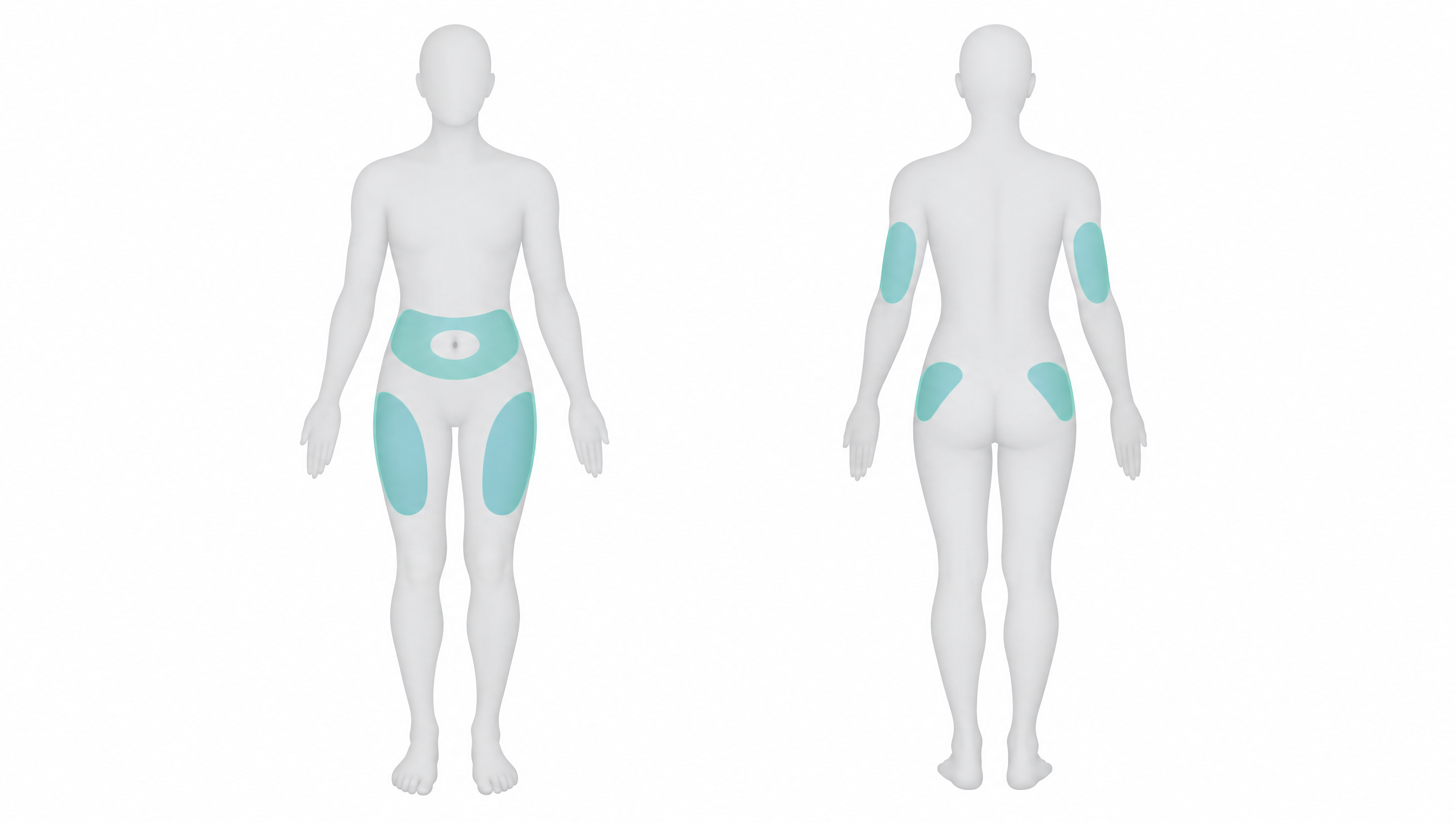
These steps follow the FITTER 2016 and FIT UK 2019 injection recommendations, written for insulin and applied here to subcutaneous peptides.
- Draw your dose in units into a U-100 insulin syringe. Insulin syringes have 6 mm or longer needles, so lift a skin fold and inject at 90 degrees into the fold.
- Keep the needle in the skin for at least 5 seconds after pressing the plunger; counting to 10 is better.
- Withdraw at the same angle, then release the fold.
- Rotate sites and move each injection at least 1 cm from the previous one. Avoid scars, bruises, lipohypertrophy and the navel.
- If your BMI is under 19, the FIT UK recommendations advise against syringe needles altogether.
- Use a new syringe and needle for every injection. If there is bleeding, press the site with gauze, do not rub.
- Dispose of needles and syringes immediately in a puncture-proof container and follow local rules.
For equipment, see injection supplies and injection accessories.
Klow peptide side effects
No clinical safety data exist for the Klow blend; reported effects are anecdotal, such as injection-site reactions, dizziness and restlessness, and injectable peptides carry a general risk of immune reactions from impurities.
The FDA adverse-event database (FAERS) contains three individual reports for injected BPC-157 through December 4, 2025 (FDA briefing, July 2026), the most relevant one for this blend being a pigmentation case after a BPC-157 and TB-500 research product that recurred on re-exposure. For KPV and TB-500 there are no FAERS reports; the FDA notes that an absence of reports does not show safety, because reporting is voluntary.
| Event | Context | Frequency per source |
|---|---|---|
| Immune reactions from aggregates and peptide-related impurities | injectable compounded products | frequency not quantifiable |
| FAERS, injected BPC-157 (through December 4, 2025) | 3 individual reports: injection-site redness and swelling over 9 days (with an additional thymosin product), shortness of breath with an emergency visit, diffuse hyperpigmentation and gum discoloration after a BPC-157/TB-500 research product (recurred on re-exposure) | individual reports without proof of causation, TB-500 share not separable |
| FAERS, KPV (through December 3, 2025) and TB-500 (through March 26, 2025) | no reports | FDA notes that an absence of reports does not show safety (voluntary reporting) |
| Dizziness | 100 µg KPV twice daily with GHK-Cu, after about 10 days | 1 forum report, resolved within 48 hours after stopping |
| Restlessness ("like a tenfold caffeine dose") | 500 µg KPV capsules from one supplier | 1 forum report |
| Inflammatory flare after stopping | 1.5 mg KPV per day over 12 weeks | 1 forum report |
| Injection-site reactions, tiredness, brief dizziness | TB-500, 2 to 5 mg subcutaneous | anecdotal, supplier page |
| Theoretical tumor and angiogenesis concern | thymosin beta-4 overexpression in a mouse melanoma model (46.7 versus 10.9 lung nodules; Cha 2003); BPC-157 acts via VEGFR2 | animal model or theoretical, no frequency |
| Supplier-listed contraindications: active or past cancer, pregnancy, breastfeeding | supplier information, no source study | no frequency |
Forum reports are single cases from one forum, not controlled evidence. A separate finding concerns skin, not injections: after microneedling with a 0.5 to 1 percent copper peptide serum, hyperpigmentation occurred in 8 of 20 participants in a study by Vignesh 2026, and the GHK-Cu guide covers topical use in detail.
Klow vs Glow peptide: what is different
It depends on the vial: the 80 mg variant used in dosing guides is Glow plus 10 mg KPV, while the 55 mg vial sold by BergdorfBio adds KPV but halves GHK-Cu to 25 mg.
| Aspect | Glow Stack | Klow (55 mg) | Klow (80 mg variant) |
|---|---|---|---|
| GHK-Cu | 50 mg | 25 mg | 50 mg |
| KPV | none | 10 mg | 10 mg |
| BPC-157 | 10 mg | 10 mg | 10 mg |
| TB-500 | 10 mg | 10 mg | 10 mg |
| Total active peptide | 70 mg | 55 mg | 80 mg |
| "Klow equals Glow plus KPV" | baseline | does not hold, GHK-Cu is halved | holds |
| Dosing scheme | none documented | none documented | guide: 7.5 to 22.5 units once daily |
Two identity checks help when you compare products. TB-500 is a fragment of thymosin beta-4, not the full 43-amino-acid protein, and KPV products differ as well: the free acid H-Lys-Pro-Val-OH and the acetylated, amidated Ac-KPV-NH2 are different substances. Human half-lives of the four components are unknown; vendor figures contradict each other and animal data, where BPC-157 has a half-life of about 5 to 15 minutes after intravenous dosing in dogs and rats (He et al. 2022).
Controlled studies of added benefit or synergy for the blend are missing; the only combination study tested BPC-157 plus TB-500 in rats and found no added benefit (Biçer et al. 2026). For the blend without KPV, see the Glow Stack guide, and for the three-peptide mix, the Glow Stack product page.
Frequently asked questions
These answers summarize what readers ask most about Klow composition, dosing, injection and status.
What is Klow peptide in simple terms?
Klow is a vendor name for a research blend of four peptides: GHK-Cu, KPV, BPC-157 and TB-500. It is sold as a lyophilized vial in two compositions, 55 mg and 80 mg, and the name is not a standardized formulation. The 55 mg vial holds GHK-Cu 25 mg, the 80 mg variant GHK-Cu 50 mg, each with 10 mg of KPV, BPC-157 and TB-500.
What is in the Klow stack?
Depending on the vial: the 55 mg product sold by BergdorfBio contains GHK-Cu 25 mg, TB-500 10 mg, BPC-157 10 mg and KPV 10 mg. Dosing guides often calculate with an 80 mg variant that holds GHK-Cu 50 mg plus the same 10 mg amounts of the other three. These composition figures are supplier data.
What are the benefits of Klow peptide?
No human study has tested benefits of the blend. Research on the components covers different areas: anti-inflammatory signaling for KPV, collagen and matrix effects for GHK-Cu, tendon and vessel models for BPC-157, and animal or lab work only for TB-500. Three small uncontrolled BPC-157 pilots and topical GHK-Cu studies are the only human data among the four.
What is the Klow peptide dosage?
One dosing guide for the 80 mg variant describes 7.5, 15 and 22.5 units once daily, then 15 units in the taper weeks. The 55 mg product page gives no schedule at all, so the unit figures come from the guide alone.
How often do you inject Klow peptide, and how much per day?
In one independent dosing guide, Klow is injected once daily: 7.5, 15 or 22.5 units of an 80 mg vial dissolved in 3 ml. That is about 2, 4 or 6 mg of blend, 250, 500 or 750 µg of KPV and 1.25, 2.5 or 3.75 mg of GHK-Cu per day. At the same solvent volume a 55 mg vial delivers the same KPV, BPC-157 and TB-500 amounts but half the GHK-Cu.
Is there a Klow peptide dosage chart?
There is no official chart and no official PDF. The tables in this guide show the reported weekly schedule for the 80 mg variant, with units on a U-100 syringe, the total amount per day, the GHK-Cu share and the KPV share.
What is the difference between Klow and Glow peptide?
It depends on the vial. The 80 mg variant used in dosing guides is Glow (70 mg) plus 10 mg KPV. The 55 mg vial sold by BergdorfBio adds KPV 10 mg but at the same time halves GHK-Cu from 50 mg to 25 mg, so it is not simply Glow plus KPV.
What is Klow 80?
Klow 80 refers to the 80 mg variant with GHK-Cu 50 mg, KPV 10 mg, BPC-157 10 mg and TB-500 10 mg. Dosing guides calculate their unit schedules with this vial. If you reconstitute the 55 mg vial instead, the GHK-Cu amount per unit changes even when KPV, BPC-157 and TB-500 stay the same.
What side effects can Klow peptide have?
No clinical safety data exist for the blend. FAERS contains three individual reports for injected BPC-157, including skin reactions and a pigmentation case after a BPC-157 and TB-500 product, and none for KPV or TB-500; the FDA notes that missing reports do not show safety. Forum users have described dizziness and restlessness.
Where do you inject Klow peptide?
Reported use is subcutaneous. Standard sites are the abdomen at least 2 cm from the navel, the upper outer thigh and the buttocks; the back of the upper arm is used only if someone else injects. With insulin syringes, whose shortest needle is 6 mm, always lift a skin fold and inject at 90 degrees.
Sources
The list below covers the studies, labels, registers and supplier pages cited in this guide.
- BergdorfBio: Klow Stack product page and KLOW Stack guide (composition as vendor data). 2026.
- BergdorfBio: Glow Stack product page (GHK-Cu 50 mg, TB-500 10 mg, BPC-157 10 mg). 2026.
- peptidedosingprotocols.com: KLOW Dosing Guide (80 mg variant, reconstitution and units). 2026.
- peptidedosingprotocols.com: KPV Peptide Dosage Chart and Protocol. 2026.
- BergdorfBio: KPV product page and KPV calculator. 2026.
- Dalmasso G et al.: PepT1-mediated tripeptide KPV uptake reduces intestinal inflammation. Gastroenterology 2008.
- UniProt: P01189, pro-opiomelanocortin (alpha-MSH 11-13). 2026.
- PubChem: Lys-Pro-Val (CID 125672).
- U.S. Food and Drug Administration: Briefing Document, PCAC meeting July 23-24, 2026: KPV-related bulk drug substances (evaluation May 12, 2026).
- U.S. Food and Drug Administration: July 23-24, 2026 PCAC meeting materials.
- McDermott Will and Schulte: PCAC backs majority of peptides in two-day public meeting (client alert, July 27, 2026; vote 8 to 6 with 1 abstention).
- Pickart L, Thaler MM: Tripeptide in human serum which prolongs survival of normal liver cells. Nature New Biology 1973.
- Maquart FX et al.: Stimulation of collagen synthesis in fibroblast cultures by GHK-Cu. FEBS Letters 1988.
- Najafi N et al.: A systematic review of the mechanisms and therapeutic applications of GHK-Cu. Archives of Internal Medicine Research 2026.
- Vignesh NR et al.: Dermaroller versus dermaroller with copper peptide in acne scars. Journal of Cutaneous and Aesthetic Surgery 2026.
- U.S. Food and Drug Administration: Bulk Drug Substances Nominated for Use in Compounding Under Section 503A (updated May 14, 2026).
- U.S. Food and Drug Administration: Certain Bulk Drug Substances for Use in Compounding that May Present Significant Safety Risks (risk page, April 22, 2026).
- Hsieh MJ et al.: Therapeutic potential of pro-angiogenic BPC157 and VEGFR2 activation. Journal of Molecular Medicine 2017.
- Lee E, Padgett B: Intra-articular injection of BPC 157 for multiple types of knee pain. Alternative Therapies in Health and Medicine 2021.
- Lee E et al.: Effect of BPC-157 on symptoms in patients with interstitial cystitis. Alternative Therapies in Health and Medicine 2024.
- Lee E, Burgess K: Safety of intravenous infusion of BPC157 in humans. Alternative Therapies in Health and Medicine 2025.
- He L et al.: Pharmacokinetics, distribution, metabolism and excretion of BPC 157 in rats and dogs. Frontiers in Pharmacology 2022.
- U.S. Food and Drug Administration: Briefing Document, PCAC meeting July 23-24, 2026: BPC-157-related bulk drug substances (includes FAERS cases).
- Biçer O et al.: Effects of BPC-157 and TB-500 on Achilles tendon healing in rats. Joint Diseases and Related Surgery 2026.
- U.S. Food and Drug Administration: Briefing Document, PCAC meeting July 23-24, 2026: TB-500-related bulk drug substances.
- Cha HJ, Jeong MJ, Kleinman HK: Role of thymosin beta4 in tumor metastasis and angiogenesis. Journal of the National Cancer Institute 2003.
- Hospira/Pfizer: Bacteriostatic Water for Injection, USP (label, DailyMed).
- Barrera F, Murvelashvili N: Poorly controlled type 3c diabetes due to use of veterinarian insulin syringes (U-100 and U-40 scales). Case Reports in Endocrinology 2019.
- Frid AH et al.: New insulin delivery recommendations (FITTER 2016). Mayo Clinic Proceedings 2016.
- Forum for Injection Technique (FIT) UK: The UK Injection and Infusion Technique Recommendations, 5th edition. 2019.
- Centers for Disease Control and Prevention: Preventing unsafe injection practices.
- U.S. Food and Drug Administration: Best way to get rid of used needles and other sharps.
