
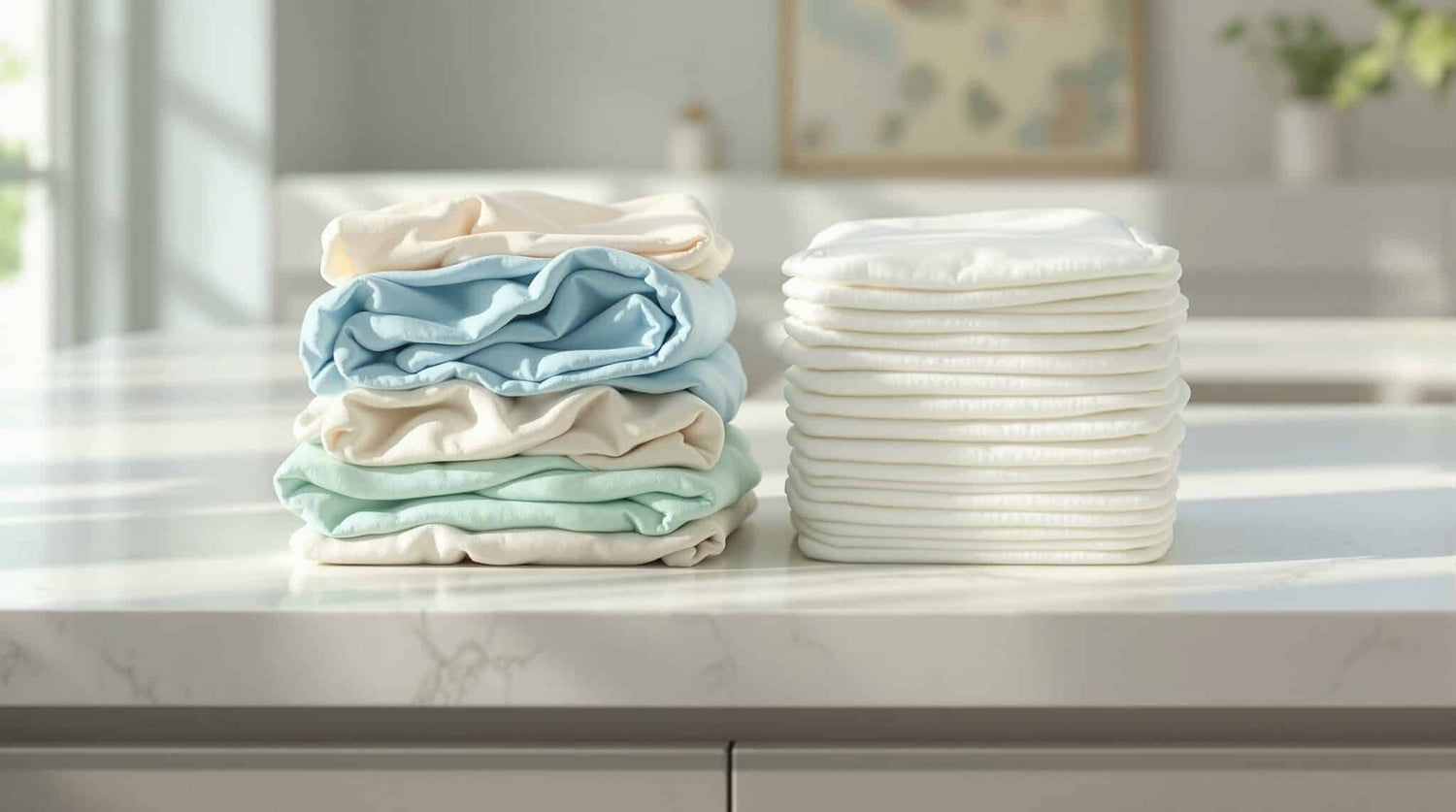
Looking for the best solution for incontinence? Here is a quick overview to help you make the decision easier:
- Reusable pads: Washable, skin-friendly, ideal for home use, environmentally friendly, cheaper in the long run.
- Disposable pads: Single use, practical on the go, high absorbency, better odor control.
Key Differences at a Glance:
| Criterion | Reusable Pads | Disposable Pads |
|---|---|---|
| Costs | Higher initial investment, cheaper long-term | Ongoing monthly expenses |
| Environment | Less waste, more sustainable | Produces lots of waste |
| Absorbency | Good for light to moderate incontinence | Suitable for moderate to severe incontinence |
| Comfort | Softer, skin-friendly | Keeps skin dry, synthetic |
| Uses | Ideal for everyday use at home | Perfect for travel and care facilities |
Conclusion:
- For everyday use at home: Reusable pads are cheaper long-term and protect the environment.
- For on-the-go or severe incontinence: Disposable pads offer practical and high-performance solutions.
Continue reading to learn details about costs, comfort, and application options.
Reusable Pads: Main Features
Construction and Lifespan
Reusable incontinence pads combine textiles and polymers to ensure high absorbency and skin-friendliness. Evolon microfiber can absorb up to 400% of its own weight in liquid. The multi-layer construction not only provides a secure fit in underwear but also makes cleaning easier.
High-quality models made from polyester-cotton blends remain waterproof and absorbent even after 300 wash cycles – approximately 2 to 3 years of daily use.
Absorption Capacity
Studies show that about 60% of pads lose 10–20% of their original capacity after 200 wash cycles. Nevertheless, the waterproof layer remains fully functional in 90% of cases.
Thanks to Evolon technology, modern pads offer the following advantages:
- Quick absorption of liquids
- Soft material for comfortable feel on skin
- Washability at temperatures up to 95°C
However, consistent absorbency requires thorough cleaning.
Cleaning Instructions
To extend lifespan and maintain functionality, follow these steps:
-
Immediately After Use
Rinse the pad under cold water until water runs clear. For heavier soiling, it is recommended to soak the pad in cold water for several hours. -
Main Wash
Use a mild detergent and wash pads in cold or lukewarm water. A wash cycle of at least one hour ensures thorough cleaning. Avoid bleach, fabric softener, or aggressive stain removers. -
Drying and Care
Air dry the pads. If using a dryer, set to low temperature. For additional hygiene, pads can be disinfected once monthly in boiling water for 10 minutes.
Disposable Pads: Main Features
Materials and Design
Disposable pads consist of multiple layers specifically designed for high absorbency and skin protection. The core combines cellulose, polyester, and polyacrylate to efficiently absorb liquids. The top layer of skin-friendly nonwoven quickly wicks moisture into the core and keeps skin dry. A waterproof underlayer prevents liquid leakage, while superabsorbent material in the core safely binds it. More on sizes and absorption levels follows in the next section.
Sizes and Absorption Levels
The absorbency of disposable pads is rated using the Rothwell Scale, which ranges from I1 (0–49 g) to I15 (2900–3299 g). The classification includes:
- Light (Rothwell I1–I3): For smaller amounts, such as with urge incontinence
- Medium (Rothwell I4–I6): Suitable for light to moderate incontinence
- Heavy (Rothwell I7–I9): For moderate to severe incontinence
- Extra (Rothwell I10+): Designed for severe incontinence
Practical tests show that actual absorption capacity is about 50% of the ISO rating. Larger pads can offer higher total capacity at the same absorption level.
Use and Disposal
In addition to functionality, proper disposal is important. Here are some guidelines:
- Fold the pad inward before throwing away
- Seal securely in a plastic bag
- Double-wrap for heavy soiling
- Do not dispose of in the toilet
Special systems like the Janibell Akord are helpful for odor control. In care facilities, additional regulations apply for disposing of clinical waste. Additionally, recycling options for incontinence products are being developed, which could offer a more environmentally friendly solution in the future.
Direct Comparison: Reusable vs. Disposable
Cost Comparison
Costs play a central role in deciding between reusable and disposable incontinence products. While disposable products cause continuous monthly expenses, these vary depending on consumption. Here is an overview:
| Product | Consumption | Estimated Monthly Cost |
|---|---|---|
| Tranquility Premium Overnight Disposable Underwear | 2 Pads/Day | €80 |
| Tranquility Premium Overnight Disposable Underwear | 4 Pads/Day | €160 |
| Prevail Extra Protective Underwear | 2 Pads/Day | €50 |
| Prevail Extra Protective Underwear | 4 Pads/Day | €100 |
| McKesson Protective Underwear Ultra | 4 Pads/Day | €80 |
| McKesson Protective Underwear Ultra | 6 Pads/Day | €120 |
A set of six MIP Ultra Fit Med-i-Brief reusable inserts costs approximately €229. With a lifespan of about 300 wash cycles, this results in annual savings of approximately €800 compared to disposable products.
Environmental Aspects and Resources
The environmental impacts differ significantly between the two options. A single reusable pad prevents approximately 1,200 disposable pads from entering landfills over its lifetime. This represents a substantial reduction in waste volume and environmental burden compared to disposable alternatives.
- Disposable products: They consist of about 80% plastic, take up to 500 years to break down, and generate significant amounts of landfill waste.
- Reusable products: They reduce energy consumption by 71%, greenhouse gas emissions by 61%, water consumption by 57%, and solid waste by 97%.
Wearing Comfort
Wearing comfort is also an important factor. There are differences here that depend on individual needs:
- Disposable products: Thanks to superabsorbent technology, they offer high absorbency and keep the skin dry.
- Reusable products: They are often more skin-friendly because they contain fewer synthetic materials, which can be especially beneficial with frequent use.
Best Uses
Choosing the right product depends heavily on the situation of use:
- Disposable products: Ideal for travel, situations with high absorbency needs, and use in care facilities.
- Reusable products: Perfect for home use, environmentally conscious users, people with sensitive skin, and long-term users.
These factors provide clear guidance when deciding on the right type of pad.
Choosing the Right Pad
The right pad depends on how often it is used and on individual needs.
Light to Moderate Use
For light to moderate incontinence, reusable incontinence pads are particularly well suited for daily use at home. They are skin-friendly and can save money in the long run. For on the go, disposable products are a good option because they are practical and easy to dispose of.
Heavy Use
For severe incontinence, a combination of different solutions is helpful. Reusable pads can be used during the day, while disposable products with high absorbency provide additional protection at night.
Eco-Friendly Options
Reusable incontinence products are a more environmentally friendly choice because they reduce plastic waste and impress with their long lifespan. With proper care, they provide reliable protection. The choice of product should also be adapted to personal circumstances, such as mobility or being bedridden.
Active vs. Bedridden Users
In addition to how often the product is used, mobility also plays an important role in the selection.
| User Type | Recommended Products | Special Features |
|---|---|---|
| Active users | Reusable incontinence underwear | Discreet, looks like regular underwear, high wearing comfort |
| Bedridden users | Combination of reusable bed pads and disposable products | Additional protection against leaks, skin-friendly |
For active people, discreet and comfortable solutions such as reusable incontinence underwear are ideal. They offer high wearing comfort and look very similar to regular underwear. Bedridden people benefit from special all-in-one incontinence briefs with adjustable sides that are gentle on the skin. A combination of both systems can help cover different needs optimally.
Final Decision Guide
Here we summarize the key points that can help you choose. Costs, environmental aspects, and comfort are decisive, as current studies show.
Cost comparison: According to two-year analyses, reusable pads are cheaper in the long run. Despite a higher initial investment, the annual costs are about €231.96, while disposable products come to approx. €1,460.
Environmental aspect: Reusable pads significantly reduce the consumption of energy, greenhouse gases, and water. The savings in solid waste are especially impressive, with reductions of up to 97%.
| Decision Criterion | Reusable Pads | Disposable Pads |
|---|---|---|
| Daily cost | €0.23 | €4.00 |
| Durability | Up to 300 wash cycles | Single use |
| Skin tolerance | Very good thanks to multi-layer construction | Good, but more frequent contact with plastics |
| Recommended for | Regular use at home | On the go, travel |
These advantages show that reusable pads are particularly suitable for everyday use at home. For travel or on the go, disposable pads can be a practical supplement. A combination of both options offers a good balance between comfort and cost-effectiveness. At parahealth, you will find a wide selection of products as well as personal advice for your individual needs.
A supporting quote from experts:
"All health care professionals have an ethical and professional responsibility to protect patient health through advocacy. Because human health is influenced by and depends on the environment, health care professionals must actively work toward implementing best practices that reduce negative environmental impacts." – Association of periOperative Registered Nurses (AORN)
Choose the product that best fits your use and your personal requirements.
Related Blog Posts
- Wound Care: The 10 Most Common Questions Answered
- Pen Needles for Diabetics: Comparison and Buying Guide 2025
- Incontinence Pads for Men: A Comprehensive Guide 2025
- Incontinence Pads for Women: A Comprehensive Guide 2025
